How GG Group Media Runs Four AI Agents Across Its Development Workflow with Agent Barn
GG Group Media is a Lithuanian digital marketing agency specialising in SEO, affiliate marketing, content strategy, PPC, and digital PR. Its development team runs four Agent Barn agents every day, turning Slack conversations into Jira tasks, writing code for simple tickets, reviewing pull requests, and keeping documentation up to date.
The challenge: agents that a whole team could use safely
GG Group Media’s developers had already experimented with AI agents. The problem wasn’t whether agents could help. It was that every agent lived on its own, set up separately, with no shared view of what it cost or what it was allowed to do. Tools like Hermes worked for the most technical people on the team, but setup was too hard for everyone else.
“With Hermes, the setup is very hard for simple users.” — Paulius Pazdrazdys
The team wanted four things: one place to manage all their agents, agents that could work in parallel, control over what they cost, and enough guardrails that the whole team could use them safely.
“We wanted to solve the problem of managing the agents from one place and making them work in our stack, get cost control of those agents, and make them safe to use for the team.” — Paulius Pazdrazdys, GG Group Media
The solution: four agents, one workflow
Today the team runs four agents, all managed from one Agent Barn workspace and used most days. Each one has a narrow job, and together they cover the path from an idea in Slack to code in production.
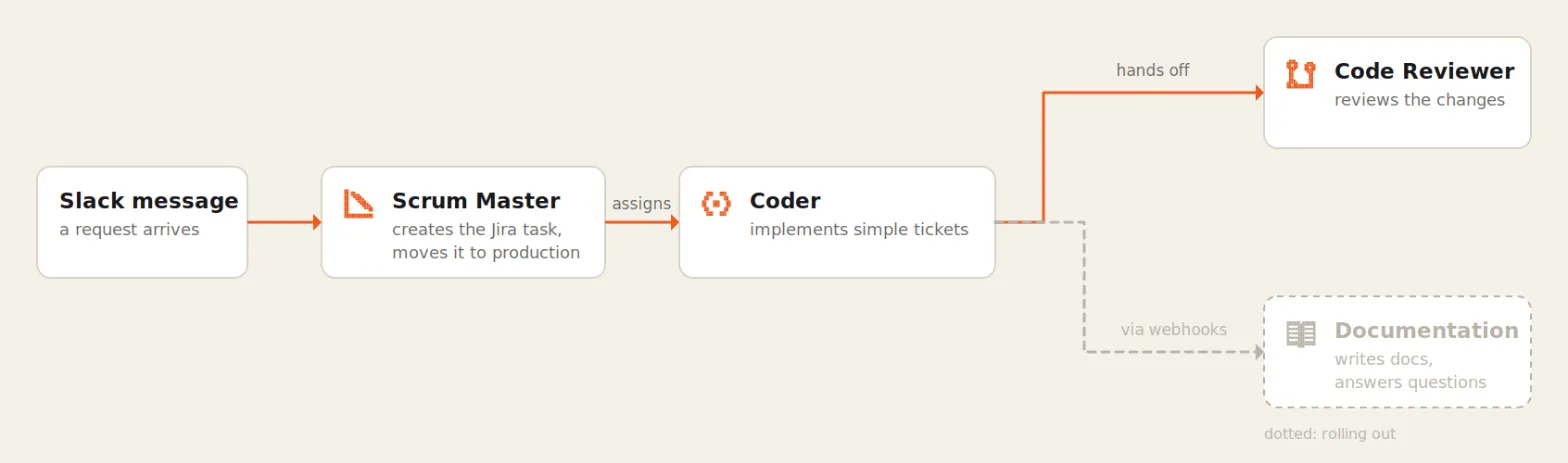
Scrum Master turns conversations into work. A developer describes a task in Slack, and the agent creates a properly structured Jira ticket: description filled in, the right people assigned, extra fields completed correctly. Recently Alexander extended it to move tickets through the whole release flow, from QA to staging to production.
“Tasks are automatically created from Slack, assigned to the people you mention, with all the details from the description filled in, and all the assignees and extra fields filled in correctly.” — Alexander Rastvortsev
Coder watches for tickets assigned to a dedicated AI user in Jira. When one appears, it implements the feature from the ticket description and updates the status. The team deliberately gives it only simple tasks and keeps complex work with people.
“We decided to assign it only easy tasks, not complex ones.” — Alexander Rastvortsev
Code Reviewer reviews the changes the Coder produces, so the automated work gets a second check before it moves on.
Documentation works in two directions. It scans GG Group Media’s many repositories and README files and, once someone approves, writes structured documentation for a feature or plugin. It also builds its own knowledge base, so anyone can ask it how part of the system works and get an answer with links to the relevant Confluence articles.
“You can ask this bot something about our system, like how we do this or that, and based on its knowledge it finds the articles and sends you the links.” — Alexander Rastvortsev
“Everything is working in automated mode right now.” — Alexander Rastvortsev, GG Group Media
Setup: configured by conversation
The team didn’t build these agents with code or long configuration files. They set each one up by telling it what to do in chat. Agent Barn found the integrations and the Jira fields on its own.
“Just talking with the bot and telling him what to do, and that’s it. All integrations, all the fields were found automatically.” — Alexander Rastvortsev
Alexander is candid that he’s an advanced user. For less technical colleagues, connecting API keys and integrations is still the hardest step, and the team suggested step-by-step guides, screenshots, and video walkthroughs to make that easier.
“For me, it’s quite easy, but I’m not a normal user. I’m an advanced one. All these integrations and keys could be quite complicated for normal users.” — Alexander Rastvortsev
When things did go wrong, the team felt supported. The rollout had some bumps, including a temporary regression in command approvals and a crash that was fixed. Both interviewees said the Agent Barn team reacted quickly, and Paulius singled out the regular check-in calls as especially helpful.
“You reacted to all the issues and tried to solve them. It was nice to have the periodic calls. I think it really helped a lot.” — Paulius Pazdrazdys
Results: work the team would miss
GG Group Media hasn’t put a number on the time saved yet, and the team is now working out how to measure it. But they’re clear about where the value sits. The Documentation agent saves the most time, and the four agents together have taken over a real share of everyday work.
“The documentation bot that’s writing all the docs is definitely saving a lot of time.” — Alexander Rastvortsev
Asked what would happen if Agent Barn disappeared tomorrow, Paulius listed the effects: creating Jira tasks would slow down, reviews would get harder, and documentation would fall behind.
“It would be a real impact for the business if we lost this. And we’re using only a small fraction of what is possible.” — Paulius Pazdrazdys
The team also values not being locked in. They currently run GLM 5.3 Flash, and they can switch models whenever a better one comes out. Paulius contrasted this with closed agent products tied to one model family.
“If a new model releases tomorrow, we can switch to it. It’s very flexible, not tied to one model family.” — Paulius Pazdrazdys
What they learned along the way
Agents are colleagues, not search boxes. Some teammates found the agents slow at first. Each answer can involve many calls to Jira, Bitbucket, and the model, so replies take time. Alexander’s advice is to treat an agent like a coworker: hand it a task, get on with something else, and pick up the answer when it arrives. Removing unnecessary approval prompts, and keeping fresh data in the agent’s memory, has made responses noticeably faster.
“You can give it a task and go do other work. If you get the answer in several minutes, it doesn’t matter. It doesn’t mean you have to wait.” — Alexander Rastvortsev
Adoption needs champions. Not everyone is eager to try another AI tool. Paulius and Alexander actively encourage colleagues to use the agents, and remind them to try again after each improvement, since people tend to report only what doesn’t work.
“People only give feedback when it doesn’t work. If it works, they don’t say anything.” — Paulius Pazdrazdys
Humans stay in the loop. The team’s goal isn’t to replace developers. They want the agents to handle most of the routine work, with a person verifying the result.
“It would be nice if it did 70 to 80% of the work. But it still needs to be verified by a human. You cannot really trust it fully.” — Paulius Pazdrazdys
What’s next
GG Group Media plans to grow well beyond the development team:
- Agents that hand off to each other. With webhooks now live, the Coder will pass finished work straight to the Documentation agent, so every merged change gets documented automatically.
- New departments. The team plans to bring agents to its commercial department and others, starting with a Telegram agent connected to Monday CRM.
- Personal agents. Alongside shared team agents, each person could have their own agent for email triage, drafting, and pulling numbers from analytics.
- More proactive agents. The team would like agents that understand their goals and suggest work on their own.
Want agents like these running on your own infrastructure? Bring us one workflow worth automating.